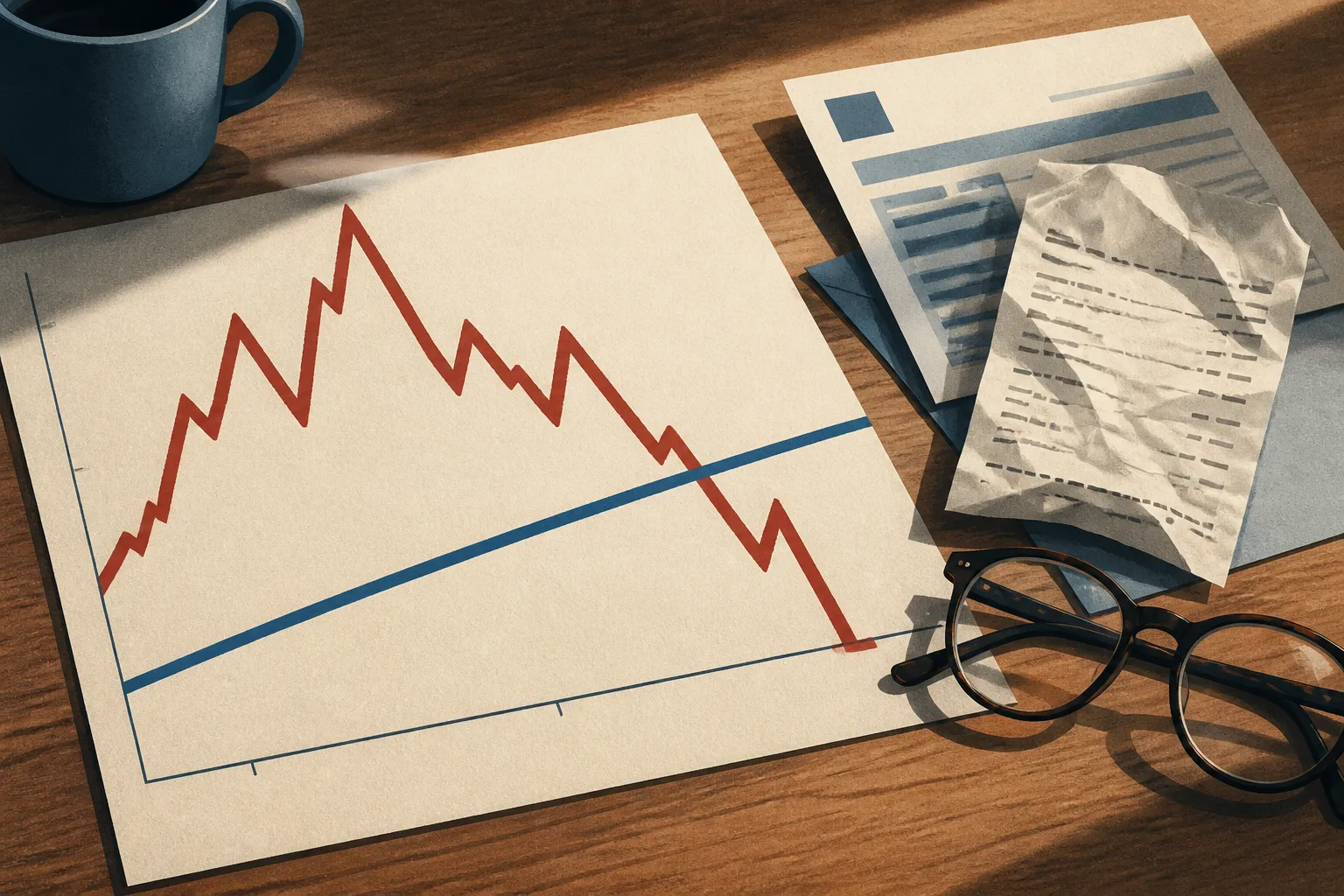

Open a savings account statement and the annual percentage yield looks like the final word. It is not. The rate your bank prints describes only one side of the ledger. The other side is what your money can buy. That is purchasing power, the amount of goods and services your dollars can actually secure. To judge your savings, you have to account for inflation, the general and sustained rise in the average price level.

The Federal Reserve Education audio lesson on real interest rates uses a bucket picture. Your balance is a bucket under a faucet. Interest is water pouring in. Inflation is a hole in the side, letting water drain out. What matters is the level left after both. If the inflow does not beat the leak, the purchasing power you hold shrinks, even while the number on your statement climbs.
Why the stated rate is only half the picture
The rate your bank shows is the nominal rate. It says how many dollars you earn. It says nothing about what those dollars will buy next year. Inflation is a broad trend across many categories of goods and services. One item getting pricier, like fuel, does not by itself mean inflation has changed. But when prices rise widely, each dollar buys less.
The same source says price stability is a responsibility of the Federal Reserve System and calls it important for savers' decisions. That makes sense. A saver who cannot guess how fast prices will rise cannot guess what a balance will be worth in five years.
A simple way to think about the math
A common shortcut for the real return is the nominal interest earned minus the inflation rate. The Federal Reserve Education source explains the idea, but its transcript does not give a worked calculation. So the numbers below are a hypothetical of ours, not the source's.
Hypothetical: an account pays 5 percent and prices rise 3 percent. The rough real return is 2 percent.
Flip it and the problem shows. If the account paid 2 percent while prices rose 3 percent, the real return would be about negative 1 percent. The balance grows on paper and loses ground at the store. Because this is a rough shortcut, check it against another source before relying on it.
You can run this test on your own account in three steps:
- Find your account's APY on your statement or the bank's website.
- Look up a current inflation figure, such as the Consumer Price Index published by the Bureau of Labor Statistics.
- Subtract inflation from the APY and see whether the result is above or below zero.
Different inflation measures give different answers, so pick one and use it the same way each time.
Forward-looking real rates are estimates
Nobody knows future inflation, so economists estimate it. The Cleveland Fed publishes a 10-year real interest rate series, available on FRED. It is a model estimate built from Treasury yields, inflation data, inflation swaps and survey-based expectations. Per the FRED note, it covers expected inflation over the next 30 years. It is a market benchmark, not a rate a bank pays a saver.
From June to October 2026, the monthly values rose from about 1.92 percent to about 2.47 percent. In between were 2.07 in July, 2.19 in August and 2.25 in September. These figures describe market conditions. They do not tell you what your own account will earn.
Why saving behavior and inflation interact
How much people save also shifts with the economy. The U.S. personal saving rate is personal income less personal outlays and taxes, divided by disposable personal income. The BEA calculates it, and BEA data via FRED shows it at 3.8 percent in September 2026. It was 4.0 percent in August, 4.5 percent in July and 4.4 percent in both June and May.
This series does not prove why households saved less or more in any month. It is a backdrop. Inflation also does not hit everyone the same way. The Federal Reserve Education source notes that borrowers and lenders are affected differently.
The practical step is small. Next time you check your balance, write down the APY, write down a current inflation reading, and subtract. If the answer is negative, your savings are losing buying power, and that is worth knowing before you decide where to keep your cash.
Please seek a professional. This article is general information, not financial, tax or insurance advice. Please seek a licensed financial, tax or insurance professional about your own situation.