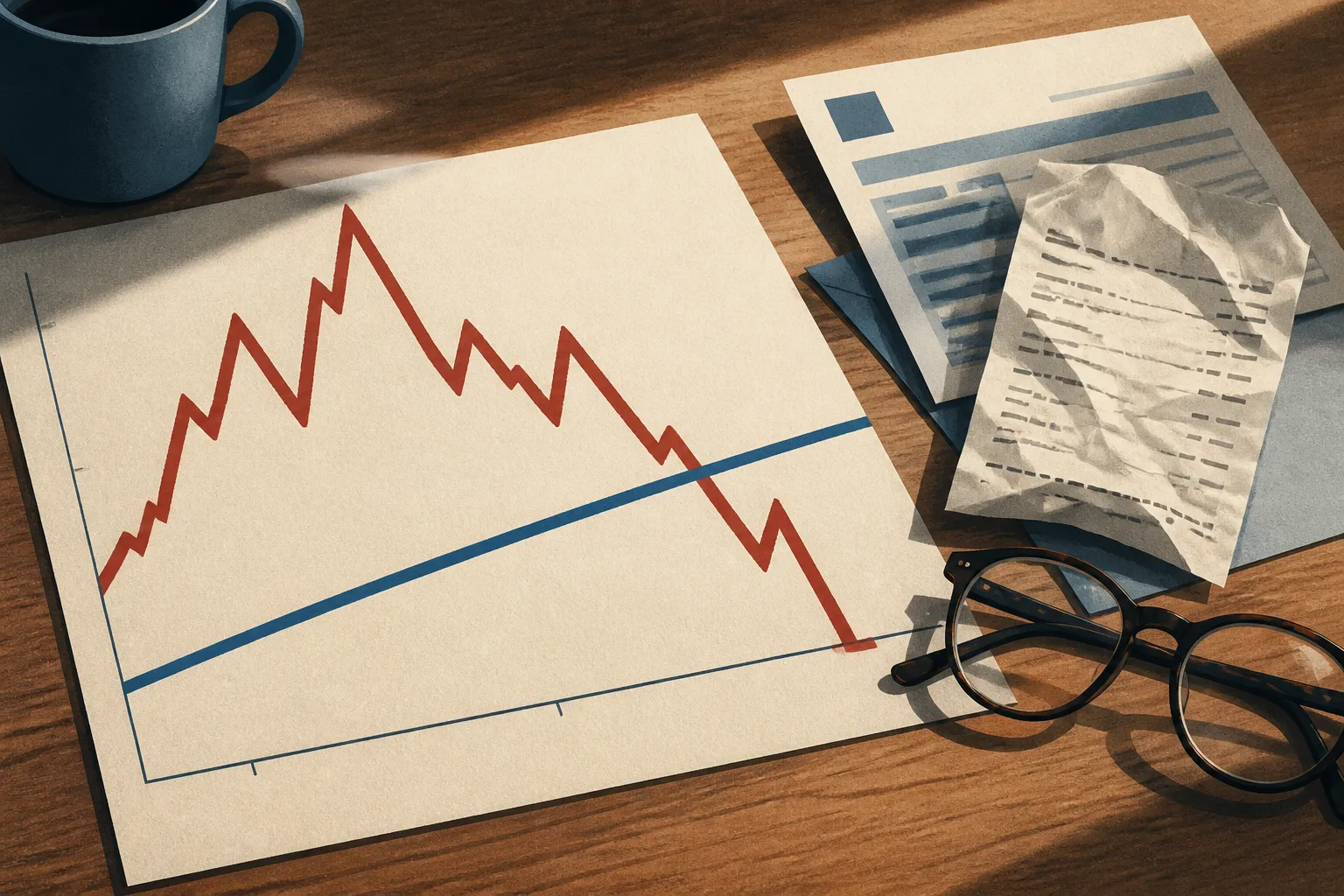

When you commit to a fixed monthly lease payment or lock in a multi-year subscription price, the dollar figure printed on your billing statement remains constant from month to month. That unchanging number, however, hides a shifting economic reality. Inflation alters the purchasing power of money over time, meaning the true burden of a dollar paid in year two or three differs from the burden of a dollar paid on day one. Evaluating any long-term agreement requires separating the stated dollar amount from what those dollars actually buy in the broader market.
- Identify the baseline nominal commitment: Record the precise monthly dollar charge stated on the contract, confirming whether that base figure is guaranteed or subject to periodic adjustments.
- Estimate the prevailing inflation environment: Check recent annual changes in official price benchmarks to gauge how rapidly purchasing power is changing across the economy.

- Calculate the real rate of payment decay: Compare the contract's fixed price against expected price shifts to determine whether the real burden of the payment is falling or rising.
- Audit contract fine print for escalation triggers: Verify whether the agreement contains hidden price escalation terms, negative option clauses, or automatic renewal rules that cancel out expected savings.
Why a Fixed Nominal Price Loses Real Value
In economics, a nominal price is the stated face value in currency, while the real price reflects actual purchasing power, or the quantity of goods and services that currency can purchase. A payment of one hundred dollars does not hold an immutable value across different years. As general consumer prices rise, each dollar purchases a smaller slice of everyday goods. When a contract binds you to pay an unchanging nominal sum over several years, the payer gradually surrenders less purchasing power with each successive payment, while the business receiving that fixed payment experiences an erosion in real revenue.
The mechanics behind this shift are straightforward. As an illustrative scenario published on the Federal Reserve Bank of St. Louis FRED blog explains, imagine a borrower taking out a one hundred dollar loan at a five percent nominal interest rate during a period when economy-wide inflation runs at ten percent. At the close of the year, the borrower repays one hundred and five dollars. If an item like a candy bar cost one dollar at the start of the year and rose to one dollar and ten cents by the end, the initial one hundred dollars could buy one hundred bars, but the final payment of one hundred and five dollars buys only about 95.45 bars. Even though the nominal return appears positive on paper, the real purchasing power returned to the lender is negative.
The same logic applies directly to long-term leases and multi-year subscription price locks. If your monthly fee is locked at a fixed nominal rate while wages and overall consumer prices drift upward, the real cost of that payment shrinks in proportion to your total budget. Conversely, during periods of falling prices or disinflation, a fixed fee commands equal or greater purchasing power over time, rendering the contract relatively more expensive in real terms than initially anticipated.
Real Rates and the Quick Approximation
Distinguishing nominal figures from real figures requires adjusting for price inflation. According to economic research from the Federal Reserve Bank of St. Louis, a nominal interest rate does not account for inflation, whereas a real rate is the inflation-adjusted rate that reflects the price of borrowing in real goods rather than in paper money. Economists commonly employ a simple rule of thumb: the real rate roughly equals the nominal rate minus the inflation rate. In notation, this is expressed as r is approximately equal to i minus pi.
This quick approximation serves well in ordinary household budgeting when inflation and interest rates are both relatively low. For example, if a financing agreement carries a four percent nominal cost and inflation runs at three percent, subtracting three from four yields an estimated real cost of roughly one percent. The arithmetic provides an immediate estimate of purchasing power changes without requiring advanced calculations.
When interest rates or inflation rates rise into double digits, however, the quick approximation loses precision. The mathematically exact calculation requires dividing the gross nominal figure by the gross inflation factor. In the candy bar example, dividing 1.05 by 1.10 yields approximately 0.9545, which corresponds to an exact real return of roughly negative 4.5 percent, compared to the shortcut estimate of negative 5.0 percent. According to educational primers from the Federal Reserve Bank of Dallas, deflating nominal values to real values using an explicit price index allows consumers to compare purchasing power across different years on an objective footing.
Fixed Prices Versus Index-Linked Escalation
Not every multi-year agreement locks your payment in stone. Commercial leases, service contracts, and select consumer subscriptions frequently separate pricing into two categories: fixed-price commitments and index-linked escalation structures. In a truly fixed agreement, the nominal dollar figure remains unchanged throughout the contract term, meaning the business bears the full risk of inflation eroding the value of its receipts.
To protect their operating margins against rising expenses, many companies insert escalation clauses. As outlined by the U.S. Bureau of Labor Statistics, contract escalation clauses link future payments to an external price benchmark, most commonly the Consumer Price Index. The Consumer Price Index measures the average change over time in the prices paid by urban consumers for a market basket of consumer goods and services. When an agreement incorporates an escalation clause tied to this index, the periodic fee automatically rises whenever the index moves upward.
The U.S. Bureau of Labor Statistics notes on contract escalation emphasize that indexing shifts inflation risk from the service provider back to the payer. An indexed payment preserves the seller's real purchasing power, but it strips the consumer of payment certainty. If inflation runs higher than expected, an index-linked subscription or lease payment can escalate significantly, removing the protective price ceiling that households often assume they secured.
Questions to Ask Before Agreeing to a Term
Before signing a multi-year lease, equipment agreement, or software subscription lock, you should examine how the contract treats inflation and cancellation. Several critical questions help clarify your exposure:
- Does the contract specify a pure fixed rate or an escalation clause? If an escalation clause exists, identify which specific index governs adjustments, whether a cap limits annual increases, and how frequently recalculations occur.
- Are there automatic renewal or negative option terms? Under federal regulatory frameworks, recurring charges must be clearly explained. On October 16, 2024, the Federal Trade Commission finalized its Click-to-Cancel rule, as announced in an official FTC press release. The rule requires companies to provide a cancellation mechanism that is as simple to complete as the original enrollment process for negative option programs.
- Were all billing conditions disclosed prior to payment? An analysis of consumer protection developments by The Legal 500 notes that the FTC's regulatory action targets practices where companies fail to obtain clear affirmative consent before billing, misrepresent material terms, or create complex cancellation hurdles.
Asking for written clarification on these points ensures that an apparent price lock does not convert into an open-ended variable expense after an introductory promotional period expires.
Warning Signs and Information Gaps
Consumers evaluating long-term commitments should watch for specific warning signs. Contracts that incorporate negative option features, where customer silence or failure to reject a notice is treated as legal agreement to a higher fee, pose substantial risks. Unreasonable hurdles, such as requiring phone calls during restricted hours or in-person visits to stop automated credit card billings, signal that a vendor may be actively impeding contract termination.
It is equally important to acknowledge the limitations of standard economic literature. Official government guides do not supply real-time forecasts of local living costs, nor do they detail how specialized consumer contracts are drafted in every industry. Consumers must consult the latest data releases from official statistical agencies to gauge current price pressures. Furthermore, formal accounting guides, such as corporate standards published by KPMG on lease accounting and guidance from PwC on lease modifications, govern how businesses recognize lease liabilities on formal balance sheets. Those corporate accounting frameworks do not govern consumer contracts or specify legal remedies for individual households when contract disputes occur. For specific disputes or contractual interpretations, consulting legal counsel or contacting state consumer protection authorities remains the appropriate course of action.