Where did the rest of the paycheck go? A zero-based budget asks that question before the money leaves. The idea is to give every dollar a purpose, from rent and groceries to savings, until there is nothing left unassigned.
Zero is the amount left to plan, not the amount left in your account.
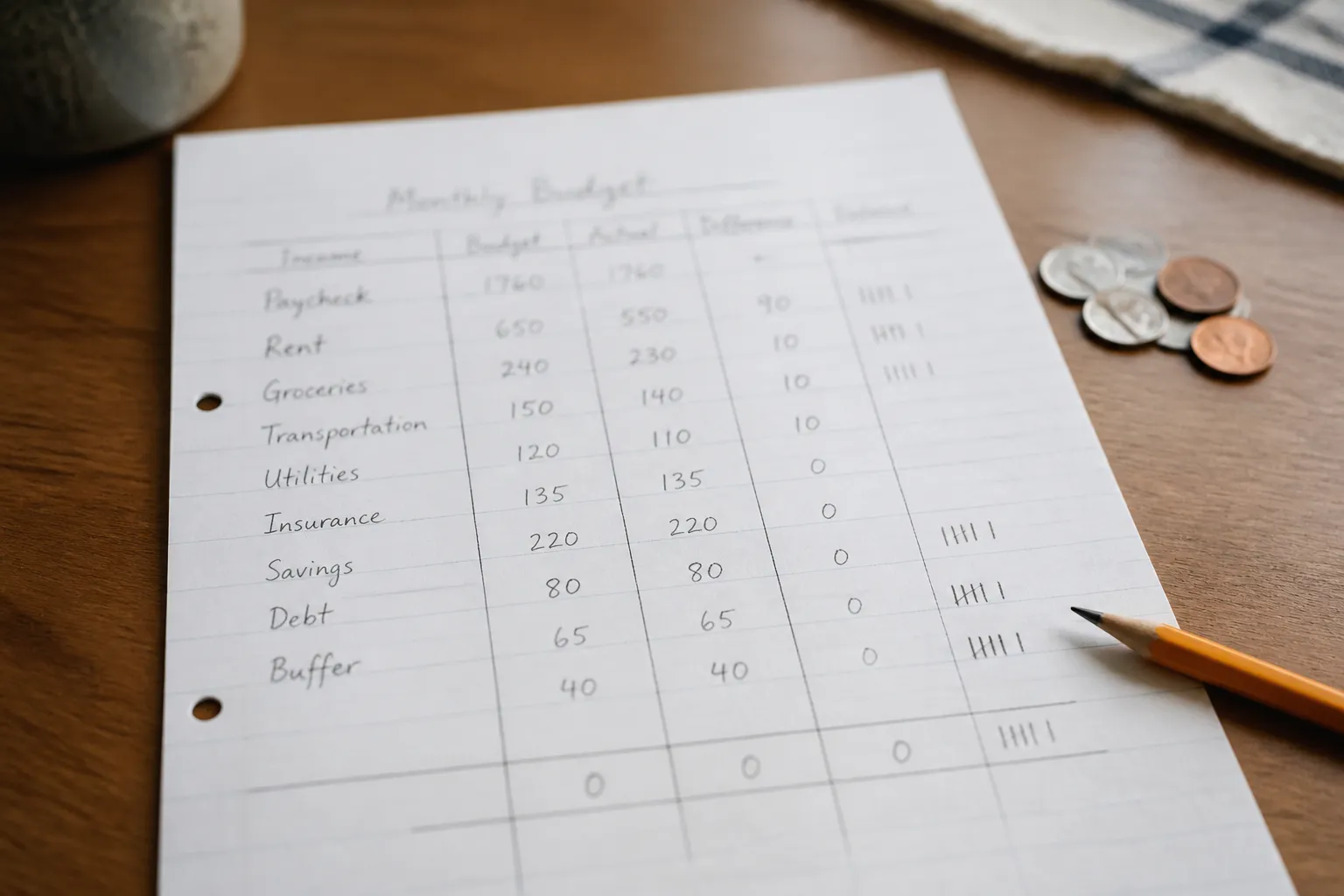
What is zero-based budgeting?
Zero-based budgeting, also called zero balance budgeting or ZBB, is a way to plan how income will be used during a set period, usually a month. The target is simple: income minus all planned allocations equals zero. An allocation is money assigned to a job. That job might be paying a bill, buying groceries, building savings or paying down debt.
Unlike a budget that starts with last month’s categories and adjusts them, a zero-based budget gives each upcoming cost a fresh look. That does not mean rent has to be a surprise every month. It means checking the amount and deciding what belongs in the new plan, rather than assuming the old plan still fits. This explanation of the method describes the trade-off: detailed planning can make spending more deliberate, but it takes time.
How do you build one?
Think of your income as a stack of tickets. Each ticket needs a destination, and you cannot hand out more tickets than you have. These steps show how the arithmetic works for a monthly budget. The amounts in the example are illustrative, not suggested spending targets.
- Choose a period and list expected income. Start with the money you expect to have available during the month. For wages, that generally means take-home pay, the amount after payroll deductions, rather than the larger number before deductions.
- List the month’s expenses. Include bills such as housing and utilities, along with expenses that change, such as groceries and transportation. Check recent statements or receipts if you are unsure what a category usually costs.
- Add other jobs for the money. Savings, debt payments and a buffer for small surprises can be categories too. A buffer is money set aside for costs you did not predict exactly.
- Subtract every allocation from income. If money remains unassigned, decide where it should go. If the result is negative, the plan calls for more money than is available, so some amounts or priorities need another look.
- Track and revise. Compare actual spending with the plan during the month. If one category needs more, money can be reassigned from another category so the plan still adds up.
For example, suppose monthly take-home income is $3,000. A sample plan assigns $1,200 to housing, $300 to utilities and phone, $400 to groceries, $300 to transportation, $250 to debt payments, $300 to savings and $250 to other spending and a buffer. Those allocations total $3,000, so $3,000 minus $3,000 equals zero.
If groceries cost $30 more than planned, the budget does not need to be thrown out. Moving $30 from the other-spending category to groceries keeps the allocations at $3,000. The important part is noticing the change and recording it, rather than pretending the first estimate was perfect.
What about costs that do not arrive every month?
A monthly plan can miss a bill that comes once or twice a year. One way to account for an expected irregular expense is to divide its estimated cost by the number of months before it is due and include that amount in the monthly plan. For instance, a $600 annual expense could be represented by a $50 monthly allocation. The money needs to remain available for that eventual bill.
Some costs are harder to predict. A savings category for unexpected expenses and a modest buffer can give a plan room to absorb changes. The research sources do not prescribe how much to set aside for emergencies or irregular bills. Amounts and priorities depend on the household and the other demands on its income.
What if income changes from month to month?
Variable income makes the zero-based calculation harder because the size of the stack may not be clear at the start. A freelancer or salesperson might receive different amounts on different dates. The Pepperdine discussion of the method notes that inconsistent income can make a steady zero-based budget difficult to maintain.
A plan can be updated as income becomes known, but the monthly total alone is not the whole picture. A bill due on the fifth needs money available by the fifth, even if another payment is expected later. Looking at due dates alongside expected income dates helps show that timing gap. If the plan depends on money that has not arrived, that uncertainty belongs in the picture too.
Who might find it useful?
Clear category limits may appeal to people with tight budgets or those working on debt, especially if they like knowing where each dollar is headed. The method can also suit someone who enjoys detail and is willing to check transactions regularly. Starting with realistic amounts and refining categories over time may make the work easier to sustain, according to the expert discussion from Pepperdine.
The same detail can feel restrictive to someone who dislikes tracking. A simpler budget based on broad categories may take less effort to maintain. Either way, a budget is a plan to revisit, not a test with a perfect first answer. If the numbers do not fit, the next useful question is which part needs to change.
Please seek a professional. This article is general information, not financial, tax or insurance advice. Please seek a licensed financial, tax or insurance professional about your own situation.