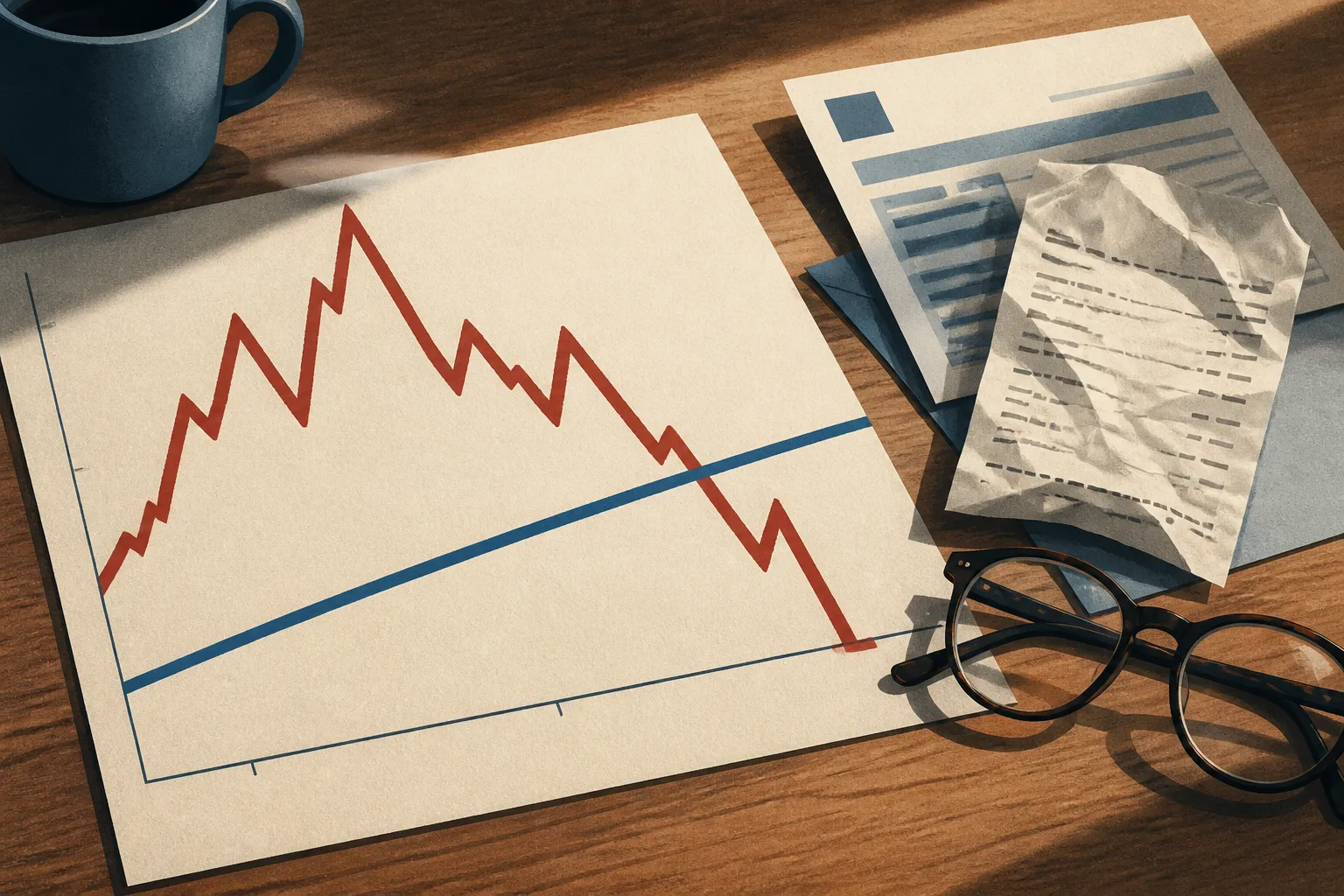

When a borrower signs a loan contract with a fixed interest rate, the dollar amount required for each scheduled payment is locked in. Over time, however, the economic value of those dollars changes. Inflation measures the pace at which prices for goods and services climb across an economy, usually tracked over a twelve-month span. As overall prices rise, each individual dollar purchases fewer goods than it did before. That shifting purchasing power alters the true burden of debt, creating a substantial difference between the dollar amount stated on a billing statement and the actual economic sacrifice required to settle it.
The inflation-adjusted cost of a fixed-rate loan depends on the gap between the contract interest rate and the pace of price increases across the broader economy.

The basic idea: nominal rates versus real rates
To understand fixed debt in an inflationary environment, one must separate nominal values from real values. Nominal figures are stated in plain dollar amounts without adjusting for changes in purchasing power. If a contract specifies an interest rate of 5 percent, that 5 percent is a nominal rate. It tells the borrower how many additional dollars must be paid for each dollar borrowed, but it says nothing about what those dollars can buy in the grocery store or at the gas pump.
The inflation-adjusted cost of that loan is what economists define as the real interest rate. The International Monetary Fund outlines this dynamic through a simplified teaching example. In that scenario, a borrower takes out a fixed-rate mortgage at 5 percent during an era when inflation also runs at 5 percent. In that specific case, the real interest rate equals roughly zero. The borrower repays the debt using dollars that, in terms of purchasing power, have lost just enough value to offset the interest charged by the contract.
This zero-real-rate outcome is not an iron law of personal finance. Rather, it serves as an educational model showing how price changes interact with financing charges. The real rate experienced by an actual household over the course of a ten-year or thirty-year loan will fluctuate depending on the loan contract terms, the exact path of inflation over that multiyear period, and whether the borrower's earnings keep pace with the cost of living.
Why a fixed balance can lose value over time
Because a fixed-rate loan maintains an unvarying schedule of nominal payments, sustained inflation erodes the real value of the remaining balance. A five-hundred-dollar monthly payment due ten years into a loan requires the exact same number of dollar bills as the first payment did. Yet if the broader price level has doubled over that span, that five-hundred-dollar payment commands half the real goods and services it once did. In economic terms, the burden of the obligation shrinks relative to the broader price environment.
This erosion is often cited as a benefit to debt holders, but the relief is not guaranteed. A household only benefits in practice if its nominal income rises alongside broader prices. When wages grow while a monthly debt payment remains flat, that payment consumes a smaller percentage of the household budget. Conversely, if household income remains flat while food, utilities, and transportation costs escalate, a fixed loan payment remains an inflexible drain on an already strained budget.
Every transaction involves two parties, and the inverse of the borrower's experience belongs to the lender. As the IMF points out, lenders see their real income decline when inflation turns out higher than what was anticipated when the interest rate was set. A financial institution that lent money at a low fixed rate expecting stable price levels ends up receiving repayments made in devalued currency. The same principle applies across other fixed payment streams. For example, the IMF notes that a retiree receiving a fixed 5 percent yearly pension increase suffers an erosion in living standards whenever inflation exceeds that 5 percent mark.
Uneven price changes and sticky incomes
Discussions of inflation often treat price increases as a uniform tide that lifts all numbers equally. In practice, price changes are uneven and irregular. The prices of raw commodities, energy, and traded goods can adjust on a daily basis in open markets. In contrast, compensation for labor is governed by employment agreements, annual reviews, and institutional policies that adjust far more slowly. Economists refer to this delayed response as wage stickiness.
This friction between fast-moving retail prices and slow-moving paychecks represents one of the primary costs of inflation identified by international economic bodies. When consumer goods jump in price before earnings adjust, real income drops. For a family managing fixed-rate debt during such a phase, the fixed nature of the loan payment does not prevent a temporary cash squeeze. The debt bill may not be getting larger, but the resources left over after buying basic necessities are getting smaller.
The opposite economic condition, known as deflation, presents its own set of challenges. When prices fall across an economy, the real burden of a fixed-rate loan increases because each dollar required for the monthly payment becomes more valuable over time. The IMF notes that falling prices can also lead buyers to delay purchases in anticipation of even cheaper goods later, which dampens overall commercial activity and can pressure employment.
Measuring expected inflation: the breakeven rate
Because unexpected shifts in price growth redistribute purchasing power between borrowers and lenders, financial markets constantly attempt to forecast future price changes. One widely referenced gauge is the 10-year breakeven inflation rate. This measure is calculated by taking the yield on a standard 10-year nominal Treasury security and subtracting the yield on a 10-year Treasury inflation-indexed security of the same maturity.
The Federal Reserve Bank of St. Louis tracks and publishes this metric through its public database. According to FRED data for the 10-year breakeven inflation rate, market expectations stood at 2.38 percent on October 28, 2026, moved to 2.35 percent on October 29, 2026, and settled at 2.30 percent on November 3, 2026. This daily series is reported in percentage points and is not seasonally adjusted, offering an ongoing reading of the average annual price change that bond market participants anticipate over the coming decade.
While the breakeven rate provides insight into market sentiment, it is an analytical indicator rather than a guaranteed forecast. It does not dictate what an individual consumer will pay for retail borrowing, nor does it reflect the exact inflation rate experienced by any single household. Consumers looking for historical measures of actual price changes typically track reports from the Bureau of Labor Statistics, which compiles the consumer price index based on representative baskets of household goods.
What the sources do not settle
Economic theory clearly outlines how nominal balances, fixed interest rates, and purchasing power interact, but high-level models leave many operational details unaddressed. The source data available here illustrates the core mechanics of nominal versus real rates, yet it does not explain how these forces play out across specific retail credit categories such as automobile loans, student loans, or personal lines of credit. Each product class operates under distinct underwriting conventions, term lengths, and legal frameworks that govern how rates are established.
Furthermore, general indicators like the 10-year Treasury breakeven rate do not directly determine retail loan pricing. The published records reviewed for this analysis do not cover the specific margins that lenders add above baseline yields, nor do they detail the mechanics of mortgage refinancing, early prepayment penalties, or federal consumer credit protection rules.
Because credit agreements are legally binding financial contracts, educational models should not be taken as individual financial, tax, or legal advice. Evaluating whether a fixed-rate obligation remains manageable requires examining individual household cash flow, contract terms, and official disclosure documents provided by lenders under federal truth-in-lending guidelines.
Please seek a professional. This article is general information, not financial, tax or insurance advice. Please seek a licensed financial, tax or insurance professional about your own situation.