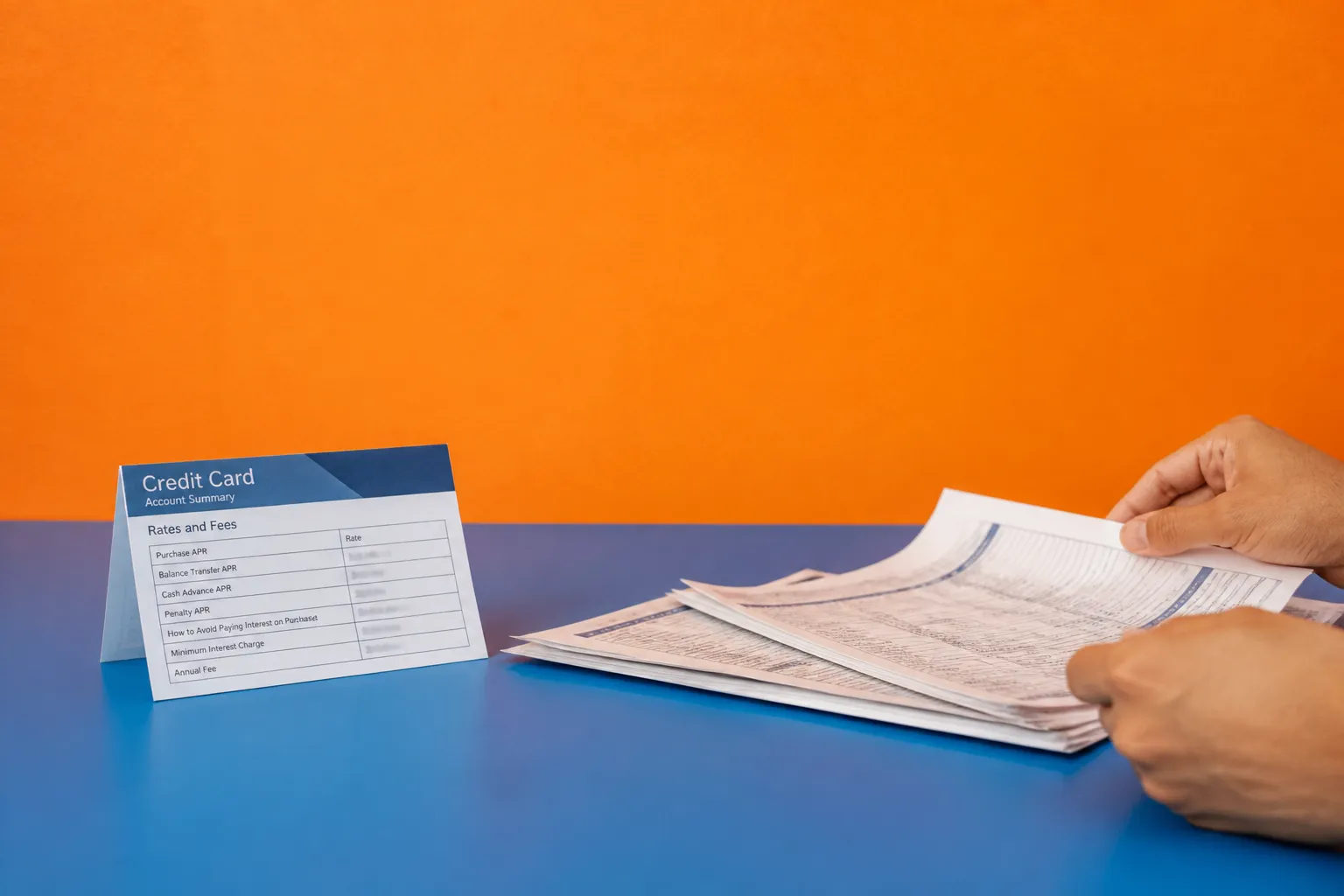

A cardholder agreement is the rulebook for your card. It is long, and most people never open it. That is a shame, because the rules about fees, your rate, and who pays for charges you did not make are all in there. Let's walk through where to find it and which parts to read first.

One note before we start. This is general education, not personal financial, legal, or tax advice. For questions about your own account, contact your issuer directly.
Where to find your cardholder agreement
Start with the issuer's website. Card issuers are generally required to post the agreements they offer to the public, with limited exceptions. The Consumer Financial Protection Bureau (CFPB) also keeps a database of agreements from hundreds of issuers. You can search it by issuer name.
One caution. The public version holds general terms, conditions, pricing, and fee information. Account-specific details, such as your own rate or credit limit, come from your issuing bank. So the public copy may not match your account exactly.
If you cannot find your copy, ask for it. By law, the issuer must make your agreement available on request. If that does not work, you can submit a complaint to the CFPB. The sources do not say how long an issuer has to respond, so ask the issuer for its timeline.
The database is also not a full history. It has no agreements for 2015, and the January 2016 archive is a sample, not a complete set. Older versions may be hard to find there.
The APR and how it is calculated
APR stands for annual percentage rate. The CFPB calls it the standard way to compare borrowing costs on an apples-to-apples basis. It must be disclosed to you before you agree to use the card.
The APR compares your interest rate and certain fees to the amount borrowed over one year. That is why an APR often differs from the simple interest rate printed elsewhere. Check both numbers. Then ask two plain questions: what is the APR, and how is it calculated?
Fees, balance transfers, and promotional rates
Fees sit in the pricing section. A balance transfer fee is usually a percentage of the amount moved or a fixed amount, whichever is more. A larger transfer can therefore cost more in fees.
Promotional rates need a close look. A zero-percent or low-interest transfer rate usually lasts for a limited time. After that, the rate may rise, and the standard rate that follows may be much higher. Find the end date and write it down.
The sources here do not explain every fee term, such as over-limit or penalty fees. For those, rely on the agreement's own definitions and the issuer's answers.
Late payments and rate increases
A late payment can cost more than one fee. According to the CFPB, if you are more than 60 days late, the issuer can raise the interest rate on all balances. That includes transferred balances.
This matters most if you carry a promotional balance. A rate increase can reach money you moved at a lower rate. So read the section on when a rate may change, and look for what triggers it. The 60-day point is a good place to begin.
Unauthorized charges and your address on file
Every agreement describes your liability for unauthorized transactions. These are charges you did not make or approve. The CFPB lists this among the terms an agreement states, so find it before you need it.
The sources do not walk through how to read that section or the dispute steps. Read it closely, and follow the issuer's instructions for reporting a problem.
Also find the part on changing your address on file. Statements and notices go to the address the issuer has on record. If it is wrong, you may miss a due date.
Checking whether the CFPB definitions apply
The CFPB's Know Before You Owe definitions apply only if your contract says it uses them. When it does, underlined terms carry those definitions as part of the contract.
The CFPB is not a party to your contract. Your agreement is between you and your issuer. So the CFPB's definitions help explain terms, but they do not replace your contract's wording.
Words that are not underlined should not be assumed to carry the CFPB meaning. Neither should words in a contract that does not say it uses those definitions. If a term is unclear, ask the issuer.
- Does my contract say it uses the CFPB definitions, and are key terms underlined?
- What fees apply, and what is my liability for unauthorized transactions?
- What is the APR, and how is it calculated?
- What is my address on file, and how do I change it?
Bring those four questions to the agreement. Read one section at a time. A highlighter helps.
Please seek a professional. This article is general information, not financial, tax or insurance advice. Please seek a licensed financial, tax or insurance professional about your own situation.