Your credit report and your credit score are related, but they are not the same thing, and mixing them up can send you looking in the wrong place when something feels off. The report is a factual record of your credit activity. The score is a number a mathematical formula produces by reading that record. One is a file; the other is a forecast. Understanding the difference takes about five minutes and can save you a lot of confusion the next time you review your credit or prepare to apply for a loan.
The report is the underlying record. The score is a prediction built from that record. When in doubt about which one matters, ask yourself: am I checking facts, or estimating how a lender might see me?
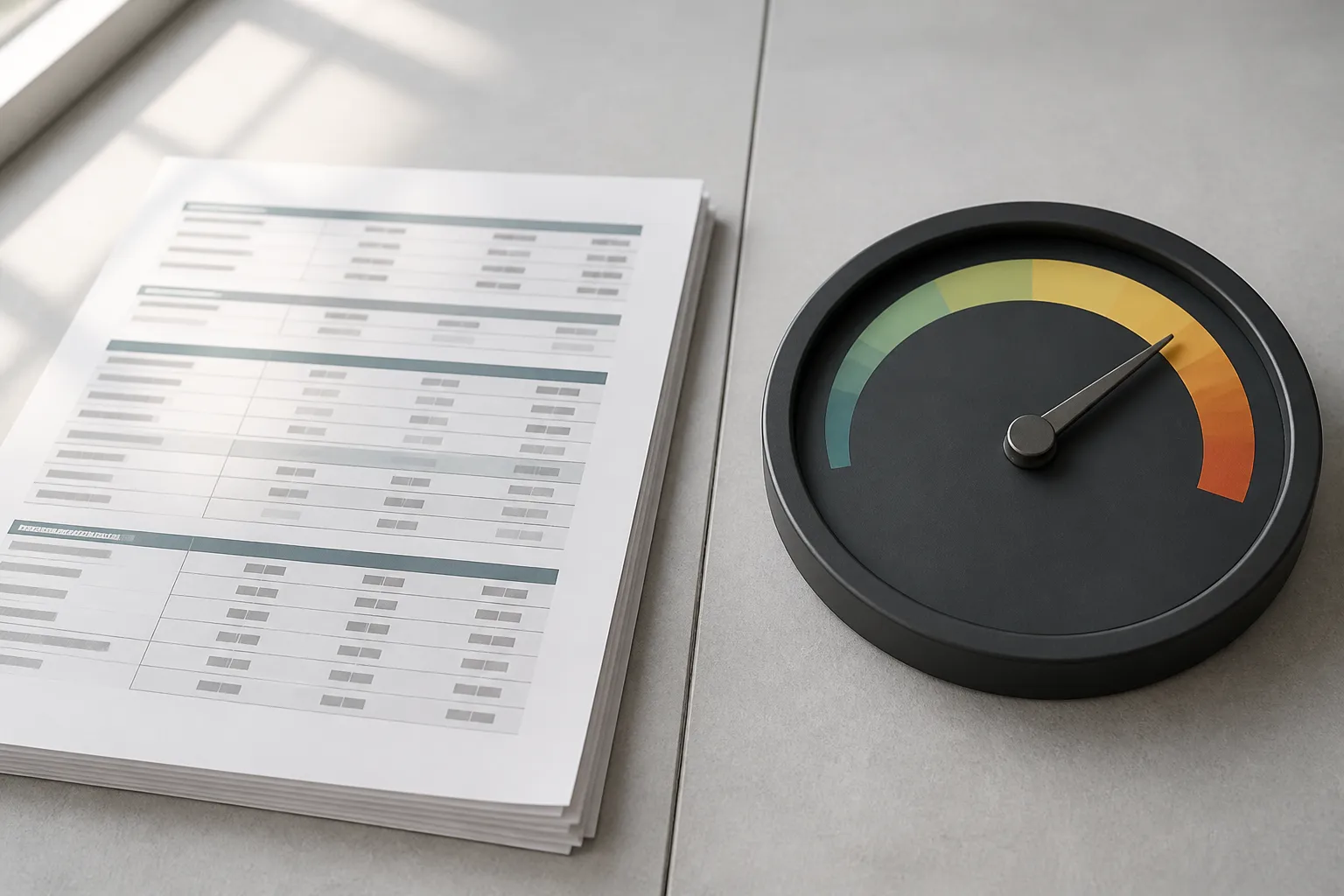
What a credit report contains
A credit report is a statement of your credit activity and your current credit situation. Think of it as a ledger. It lists things like your loan payment history, the status of open and closed accounts, any collections, and public records such as bankruptcies. Nothing in the report is an opinion or a grade. It is simply what happened, as reported by your creditors.
Credit reporting companies, also called credit bureaus or consumer reporting agencies, collect this information from lenders and other sources, then compile and sell the reports. The Consumer Financial Protection Bureau (CFPB) supervises large non-bank entities of this kind, and it accepts consumer complaints about them. So if you believe something in your report is wrong and the reporting company will not fix it, you have a federal regulator you can contact. The CFPB's credit reports and scores page outlines your rights and next steps.
Because the report is a record rather than a judgment, it is the place to go when you want to verify that the information about your accounts is accurate and complete. Errors show up more often than most people expect, and even a small mistake can affect how other calculations treat your file.
What a credit score predicts
A credit score is a prediction of how likely you are to repay a debt on time. Scoring models, which are mathematical formulas, read the data in your credit report and convert it into a number. Most scores fall somewhere between 300 and 850. A higher number generally makes it easier to qualify for credit and may come with a lower interest rate or more favorable terms.
Lenders and other companies use scores to make decisions across a wide range of products and services, including mortgages, credit cards, auto loans, tenant screening, and insurance. They also use scores when setting credit limits and interest rates. The factors a scoring model typically weighs include your bill-paying history, the amount of debt you currently carry, how many and what types of accounts you have, how long those accounts have been open, how much of your available credit you are using, and whether you have recent applications for new credit. Events like a debt going to collections, a foreclosure, or a bankruptcy also factor in, as does how long ago those events occurred.
An error on your report can push a score lower than it should be, which could translate into a higher interest rate. This is one concrete reason to review your report for mistakes well before you apply for anything, not after.
Why you can have more than one score
There is no single score that every lender uses. The number you see when you check a score through one source may differ from the number a lender pulls, sometimes by a meaningful amount. Several things account for the gap: different scoring models, different underlying data, different sources for that data, different loan product types, and even the specific day the score was calculated.
According to the CFPB, a score can differ based on the data used, the scoring model, and the loan product type, among other variables. When a lender gives you a score or references one in a decision, it is worth asking which credit reporting agency supplied the data and which scoring model was applied. Those two details help explain where the number came from and why it may not match one you have seen elsewhere.
Since every score is built on report data, the most reliable thing you can do is keep the report itself clean. Errors on the underlying record ripple into every score calculated from it.
Checking your reports and understanding broader protections
Pulling your own credit reports does not hurt your credit score. The CFPB recommends checking your reports at least once a year for errors, and reviewing them before you apply for a loan gives you time to dispute mistakes before a lender sees them. This kind of self-review is a consumer right, not a commercial service.
Credit monitoring is a separate product that charges a fee to watch your reports and send alerts when something changes. Those alerts largely overlap with what you can discover through your own periodic reviews, so it is worth comparing the ongoing cost against the free option of simply reading your reports yourself before signing up for a paid plan.
Other protections exist beyond the standard credit report. Fraud alerts, security freezes, and military active duty alerts are tools that can limit who can access your file or pull a new inquiry. Tenant screening reports and specialty consumer reporting company files are separate records entirely. If you have been denied housing, you have the right to request a copy of your tenant screening report to review what it contains.
The scale of people who fall outside the standard credit file is larger than most consumers realize. The CFPB has estimated that roughly 26 million Americans have no credit history with the three nationwide credit reporting companies, making them what researchers call "credit invisible." Another 19 million have files that are either too thin or too old to produce a reliable score. Together, that is roughly 45 million people who may face difficulty accessing credit because no scorable record exists for them, a detail that underscores just how much weight this system carries in everyday financial life.
Questions worth asking before you act
When you sit down to review your credit, start with one clarifying question: do I need the underlying record, or do I need an estimate of how a lender might see me? The report answers the first question. A score answers the second. Getting clear on that before you search saves time and prevents confusion when the numbers or records you find do not match your expectations.
If you are looking at a score, ask which credit reporting agency supplied the data behind it, which scoring model was used, and which loan product type the score was calculated for. If you are reviewing a report, check each account listed for accuracy, paying attention to payment history entries, balances, and anything that looks unfamiliar. The CFPB's plain-language explanation of the difference between a report and a score is a reliable starting point, and the agency's credit score page goes deeper on how scoring models work and what factors they typically consider.
None of this requires expertise. It requires knowing what each document actually is and what question each one is designed to answer. A report shows what happened. A score predicts what might happen next. Both matter, and both start with the same underlying data.
Please seek a professional. This article is general information, not financial, tax or insurance advice. Please seek a licensed financial, tax or insurance professional about your own situation.