










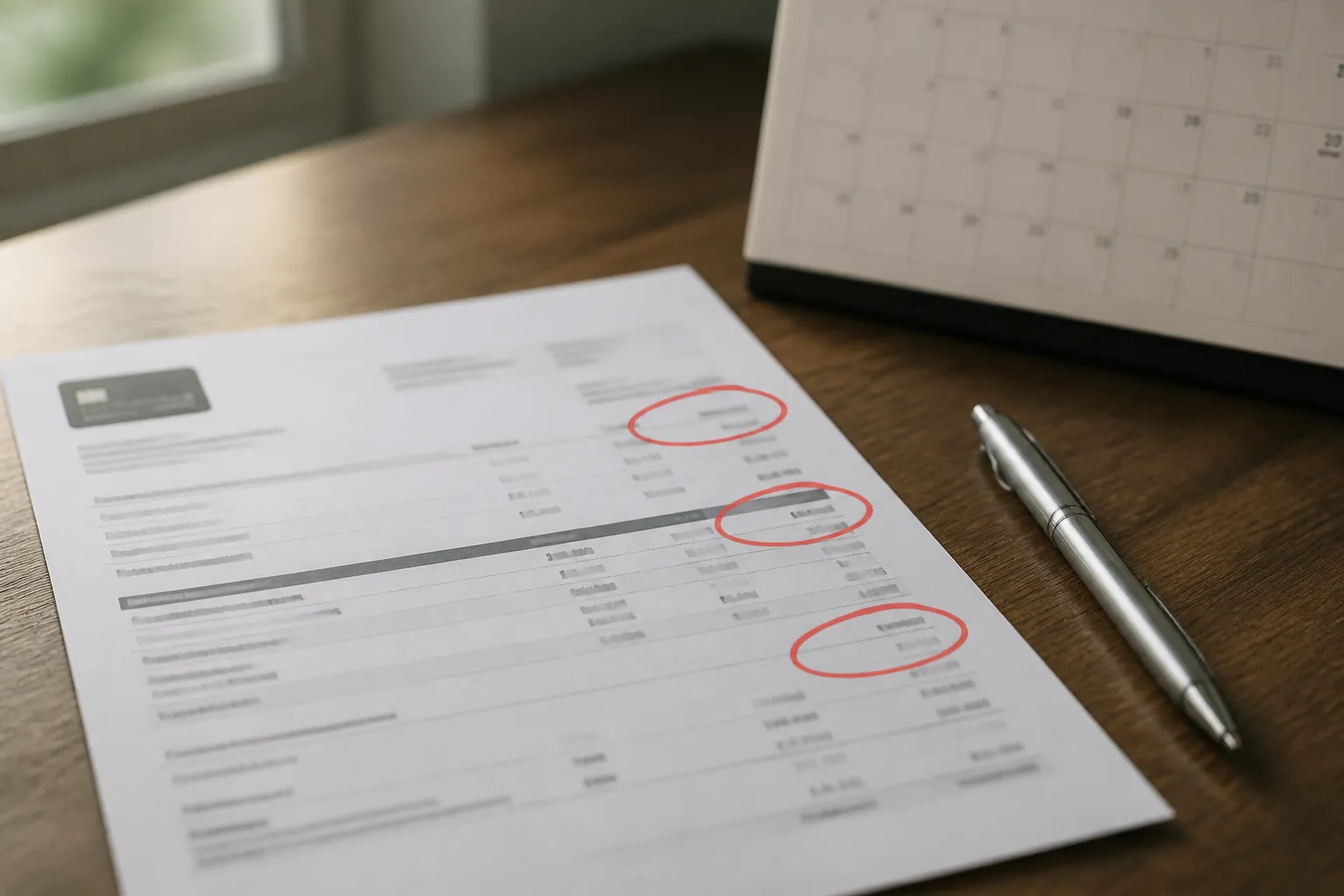
A credit card payment has more than one deadline. People mix them up all the time. Let's walk through each one slowly, in the order they show up on your statement.
The closing date ends the billing cycle. The due date is the day you owe at least the minimum. They are not the same day.

How a billing cycle works
A billing cycle is the stretch of time between two statement closing dates. It usually runs 28 to 31 days. Purchases, fees and payments made in that window get added up on one statement.
The closing date is the last day of the cycle. A purchase made after that date generally lands on the next statement, not the current one.
Each cycle, the issuer (the company that gave you the card) totals your transactions. It carries forward any unpaid balance from before. Then it sends a statement. That statement shows your balance, your minimum payment and your due date.
Closing dates and due dates are different deadlines
The due date comes later. It is the day you must pay at least the minimum. Issuers must give you at least 21 days from the statement to pay. So the due date usually falls about 21 days after the closing date.
The Credit CARD Act of 2009 says the due date must fall on the same calendar date each month. One issuer's example: a July 18 due date becomes August 18 the next month. Issuers will generally move the date if you ask, so it is fair to ask whether a different day of the month is possible.
A grace period is the window when you can avoid interest on new purchases by paying the full statement balance. Grace periods are usually 25 to 55 days. If yours applies, paying the full statement balance by the due date generally avoids purchase interest.
Cut-off times and how payments are counted
The CFPB explains that a card company generally cannot treat your payment as late if it arrives by 5 p.m. on the due date. That is the time zone printed on your statement. If the due date lands on a Sunday or a holiday, the 5 p.m. deadline generally moves to the next business day.
Issuers can also set their own reasonable cut-off for online payments. They can set an earlier cut-off for in-person payments, based on when a branch or office closes. These times differ by issuer. Your statement and the issuer's payment terms are where to confirm them.
One more rule matters. The payment must be received by the due date. Mailing it that day is not enough. Online and phone payments can take time to process too.
Posting times can be very specific. One issuer's published schedule dates online or phone payments made Sunday to Friday before 7 p.m. Eastern as same-day. Payments after that on a statement cycle date are credited the next day. Another issuer will have a different schedule. Do not assume yours matches.
Practical steps and questions to ask
Start with the statement. Look for these four things:
- The closing date
- The due date
- The time zone
- Any stated cut-off times
Pay before the due date if you can. That leaves room for mail delays and processing. A payment can be credited on a different day than the day you made it. Your available credit may update later still. So ask when a payment made today will be credited.
Here are other questions worth asking your issuer:
- What time zone and cut-off time does my statement use?
- Is my online or in-person cut-off earlier than 5 p.m.?
- Can my due date be moved?
If you were charged a late fee on a payment received by 5 p.m. on the due date, it may be worth questioning. If a payment truly arrived late, you can ask the issuer to consider waiving the fee. It does not have to agree.
Issuers generally report balances to the credit bureaus around the closing date. So the balance on your statement can affect your credit utilization, which is the share of your limit you are using. The sources I reviewed do not explain how late payments affect credit scores or penalty interest rates. The CFPB and the credit bureaus' consumer pages are the places to ask. No result is guaranteed either way.
Please seek a professional. This article is general information, not financial, tax or insurance advice. Please seek a licensed financial, tax or insurance professional about your own situation.


